

Read summarized version with:
 ChatGPT
 Gemini
 Perplexity
 Claude
 Grok
Grok
ESG scores measure how well a company manages its environmental impact, relationships with people, and internal governance. Investors, procurement teams, banks, and regulators all use these scores to judge whether a company is built to last or carrying hidden risks.
This guide breaks down everything you need to know: what ESG scores mean, how they are calculated, what a good score looks like, how to improve one, and the real criticisms you should know before you rely on them.
What Is an ESG Score?
An ESG score is a number that rates how responsibly a company operates across three areas: the environment, its people, and how it runs itself internally.
The higher the score, the better a company performs on factors like carbon emissions, worker safety, and ethical leadership. Rating agencies calculate these scores using company disclosures, public records, third-party audits, and news monitoring.
Think of it like a credit score, but instead of measuring financial reliability, it measures sustainability and ethical reliability.
Jargon note: “Disclosures” simply means information a company makes public, such as annual reports, sustainability reports, and regulatory filings.
The Three Pillars of ESG
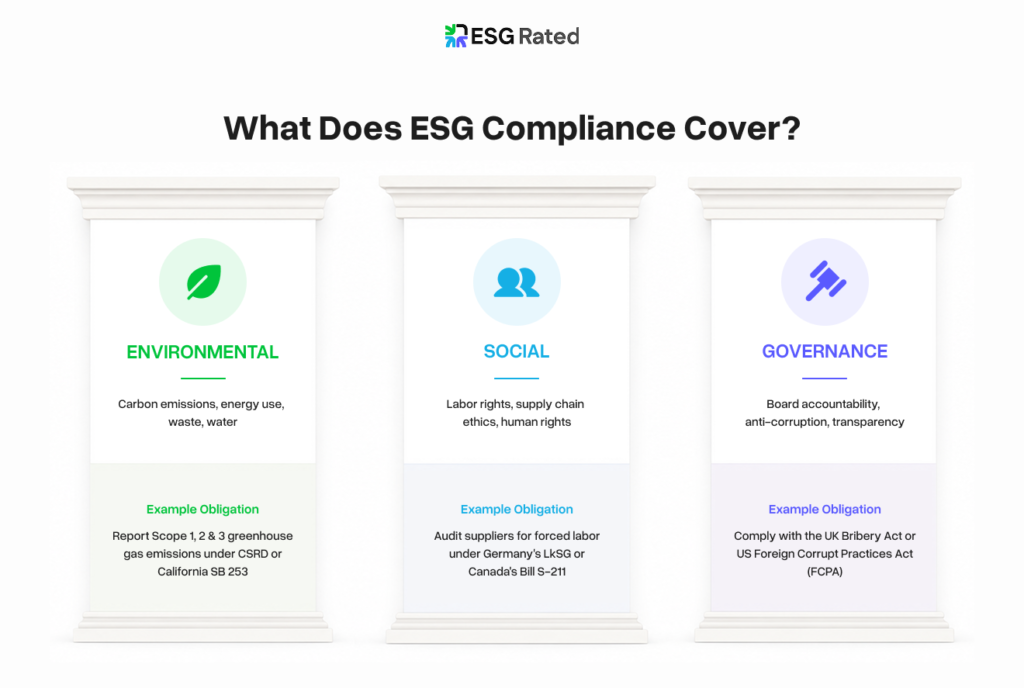
Environmental (E)
This pillar covers how a company interacts with the natural world.
Key factors include:
- Carbon emissions and greenhouse gas output
- Energy consumption and renewable energy use
- Water usage and waste management
- Supply chain environmental impact
- Biodiversity and land use
Social (S)
This pillar covers how a company treats people, both inside and outside its walls.
Key factors include:
- Employee health, safety, and fair wages
- Diversity, equity, and inclusion policies
- Labor rights across the supply chain
- Community investment and charitable impact
- Data privacy and customer protection
Governance (G)
This pillar covers how a company runs itself at the leadership level.
Key factors include:
- Board composition and independence
- Executive pay and transparency
- Anti-corruption and anti-bribery policies
- Shareholder rights
- Accuracy and openness of financial reporting
Who Calculates ESG Scores?
Several independent rating agencies calculate ESG scores, each using its own methodology. This is why the same company can receive different scores from different providers — and why the way a score is calculated matters just as much as the score itself.
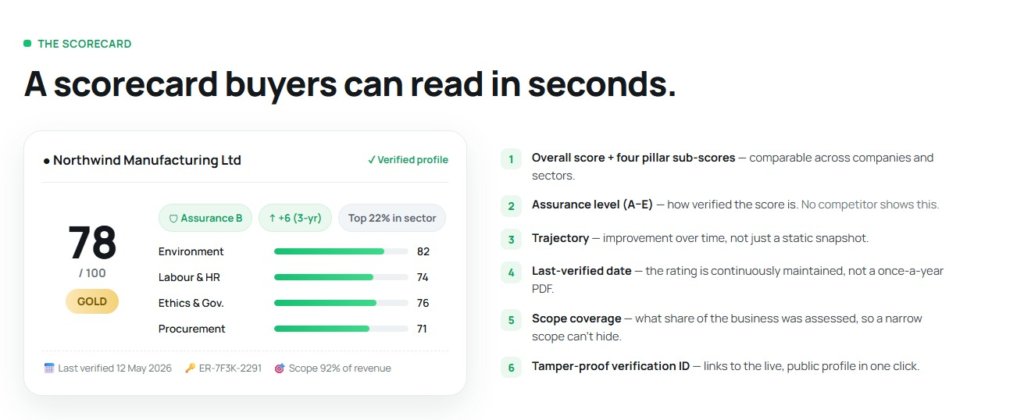
ESGrated.com takes a different approach to this problem. Rather than giving companies a single number and leaving buyers to guess how reliable it is, ESGrated publishes two signals for every assessment:
- Performance Score (0–100) — how well the company actually performs on ESG, mapped to tiers: Committed, Bronze, Silver, Gold, and Platinum.
- Assurance Level (A–E) — how independently verified that score is.
This second axis is what most conventional ratings leave out entirely.
How Is an ESG Score Calculated?
ESGrated follows a structured, evidence-based process tied directly to its Assurance Level system.
The Assurance Level (A–E) reflects how the data was collected and verified:
- A – Audited: Independently assured by a third-party auditor
- B – Verified: Documentary evidence reviewed line-by-line by ESGrated’s analysts
- C – Reviewed: Self-reported data, sense-checked by an analyst
- D – Declared: Self-reported, not yet independently checked
- E – Estimated: Modelled or inferred where primary data is unavailable
Raising a company’s Assurance Level for example, by connecting primary data sources or commissioning an external audit — increases buyer confidence without artificially changing the performance score. This keeps the two signals honest and independent of each other.
The Performance Score itself is broken into four pillar sub-scores, each assessed separately:
- Environment
- Labour & Human Rights
- Ethics & Governance
- Sustainable Procurement
What Is a Good ESG Score on ESGrated?
ESGrated uses a 0–100 performance scale that maps to five tiers:
| Tier | Score Range |
|---|---|
| Committed | Baseline met |
| Bronze | 55 – 64 |
| Silver | 65 – 74 |
| Gold | 75 – 84 |
| Platinum | 85 – 100 |
But the score alone does not tell the full story. A complete ESGrated rating reads like this:
Gold (78/100) · Assurance B · ↑ Improving · 92% coverage
The two qualifiers that travel with every rating:
| Qualifier | What It Shows |
|---|---|
| Trajectory | Whether the score is improving, stable, or declining over time |
| Coverage | What share of the business (by revenue, sites, or spend) the assessment actually covers |
This means a buyer can see not just how a company scores today, but whether to trust that number and whether it covers the whole business — not just a convenient slice of it.
How Companies Use ESG Scores
1. Investment and Capital Decisions
Institutional investors use ESG scores to build portfolios, screen out high-risk companies, and satisfy regulations that require sustainable investment strategies.
Private equity firms use them to assess portfolio companies before and after acquisition. Firms with strong ESG performance are considered lower risk and easier to exit at premium valuations.
Banks and lenders use ESG scores for green loans and sustainable finance products. A company with a strong ESG rating may receive better interest rates on loans, known as ESG-linked financing.
2. Supply Chain and Procurement
Large corporations request ESG scores from their suppliers to manage risk and meet their own regulatory reporting obligations. If a supplier scores poorly on labour rights, the buyer faces reputational and legal risk by association.
EcoVadis ratings are especially common in this context. Companies like Nestlé, L’Oréal, and Renault use supplier ESG scores to decide who to work with and on what terms.
3. Sustainable Supply Chain Finance
Corporate buyers and financial institutions now link early invoice payment programmes to supplier ESG performance. Suppliers with better scores unlock faster payment or cheaper financing. This creates a direct financial incentive for smaller suppliers to improve their sustainability practices.
4. Brand and Reputation Management
A high ESG score signals to customers, employees, and media that a company operates ethically. This matters especially in consumer-facing industries, where public trust drives sales.
How to Improve Your ESG Score
Environmental Improvements
Cut your carbon footprint. Set a science-based emissions reduction target. Switch to renewable energy for your operations and measure your full Scope 1, 2, and 3 emissions.
Jargon note: Scope 1 emissions come directly from your operations (like fuel burned in company vehicles). Scope 2 comes from the electricity you buy. Scope 3 covers your entire supply chain and product lifecycle, which is usually the largest category.
Manage resources better. Reduce water consumption, increase recycling rates, and adopt circular economy principles where you reuse materials instead of discarding them.
Report transparently. Publish an annual sustainability report aligned with recognised frameworks like GRI (Global Reporting Initiative) or TCFD (Task Force on Climate-related Financial Disclosures).
Social Improvements
Strengthen diversity and inclusion. Set measurable targets for gender balance, ethnic diversity, and pay equity. Report progress annually.
Protect worker rights. Audit your supply chain for forced labour, child labour, and unsafe conditions. Address problems you find, do not just report them.
Invest in your community. Move beyond one-off donations. Partner with local organisations, create employment programmes, and measure the actual community impact.
Governance Improvements
Build a balanced board. Boards that include independent directors, diverse representation, and relevant expertise make better decisions and score higher.
Enforce a zero-tolerance ethics policy. Implement and enforce clear anti-corruption and anti-bribery policies at every level of the organisation, from frontline staff to the board.
Make ESG reporting reliable. Third-party verification of your ESG data builds credibility with rating agencies and stakeholders. Self-reported data with no external verification carries less weight.
ESG Regulations Around the World
Governments are no longer leaving ESG reporting to company discretion. Mandatory disclosure requirements are tightening fast.
European Union
The EU leads the world on ESG regulation. The Corporate Sustainability Reporting Directive (CSRD) requires large companies to disclose detailed sustainability information under the European Sustainability Reporting Standards (ESRS). The CSRD’s scope has been significantly narrowed following the Omnibus package agreed in December 2025 and adopted in February 2026, which reduced the number of entities in scope by around 90%. Under the revised thresholds, only companies with more than 1,000 employees and at least 450 million euros in net annual turnover are required to report. Listed SMEs are fully exempt under the new framework.
The Sustainable Finance Disclosure Regulation (SFDR) requires financial institutions and asset managers to classify their funds by sustainability level and disclose how they consider ESG risks. This directly affects how investment products are labelled and sold.
United States
The SEC adopted climate disclosure rules in March 2024, but the rules never took effect. The Commission stayed them pending legal challenges, and in March 2025 voted to end its defence of the rules entirely. As of May 2026, the SEC has proposed to rescind the rules in full, arguing they exceed the agency’s statutory authority. At the state level, certain states including California are moving ahead with their own climate disclosure requirements that in some cases go further than the federal rules would have.
United Kingdom
The UK has been an early mover on mandatory climate disclosure, having required TCFD-aligned reporting from 2021 and 2022 for listed entities and from 2022 and 2023 for certain FCA-regulated firms. The framework is now being updated. In February 2026, the government published final UK Sustainability Reporting Standards based on the ISSB’s global standards, and the FCA is consulting on proposals to require listed companies to report against these from 1 January 2027. The FCA continues to oversee sustainability disclosure requirements for asset managers through its SDR regime, which includes anti-greenwashing rules for all regulated firms.
India
India has made significant ESG progress in a short time. The Business Responsibility and Sustainability Report (BRSR), introduced by SEBI (Securities and Exchange Board of India), requires the top 1,000 listed companies by market capitalisation to publish detailed sustainability disclosures covering environmental impact, social responsibility, and governance practices.
SEBI also introduced BRSR Core, a refined subset of key ESG metrics requiring third-party assessment. The rollout is phased: the top 150 listed companies were required to comply from FY 2023 to 2024, expanding to the top 250 in FY 2024 to 2025, the top 500 in FY 2025 to 2026, and the full top 1,000 by FY 2026 to 2027. This makes India one of the few emerging economies with a structured, mandatory ESG reporting framework backed by external assurance requirements.
China
China requires environmental disclosures for heavy-polluting industries and is expanding green finance taxonomies, though mandatory ESG disclosure for all listed companies is still developing.
Real-World ESG Examples
Apple (High Performer)
Apple has committed to being carbon neutral across its entire supply chain and product life cycle by 2030. It reports detailed Scope 1, 2, and 3 emissions and publishes annual environmental progress reports verified by third-party auditors. As of its most recent progress report, Apple has surpassed a 60% reduction in global greenhouse gas emissions compared to its 2015 baseline. Apple currently holds an MSCI ESG rating of BBB. Suppliers who fail to meet Apple’s environmental standards risk losing contracts.
Volkswagen (Governance Failure)
In 2015, Volkswagen deliberately installed software in diesel vehicles to cheat on emissions tests. This is now called “Dieselgate.” The scandal wiped over 30% off Volkswagen’s share price within days and has cost the company more than 32 billion euros in fines, refits, and legal costs, with settlements still being finalised in various countries as recently as 2024. It remains one of the clearest examples of how poor governance and ethics directly destroy shareholder value.
Infosys (India, Strong ESG Performance)
Infosys became carbon neutral in 2020, achieving the milestone 30 years ahead of the Paris Agreement timeline, and has now maintained carbon neutrality for seven consecutive years. The company runs its campuses substantially on renewable energy and publishes detailed ESG disclosures aligned with GRI standards. Infosys is now advancing beyond carbon neutrality toward climate positivity through regenerative practices and nature-based solutions, and consistently ranks among the highest-rated Indian companies in global ESG indices.
Boohoo (Social Failure)
In 2020, investigations revealed that garment workers in Boohoo’s UK supply chain were paid below minimum wage and worked in unsafe conditions. The company’s share price fell by approximately 40% within days. This illustrates the direct financial risk that poor social scores and weak supply chain oversight create.
Tata Steel (India, ESG Transition)
Tata Steel has committed to achieving net zero carbon by 2045 and is investing in new decarbonisation technologies including hydrogen-based steelmaking to replace coal-fired blast furnaces. It publishes annual sustainability reports and has been part of the DJSI Emerging Markets Index since 2012, consistently ranking among the top 10 steel companies in the DJSI Corporate Sustainability Assessment since 2016. The company has also been recognised as a Steel Sustainability Champion by worldsteel for eight consecutive years as of 2025. This shows how a traditionally high-emission industry can pursue a credible ESG transition.
Criticisms and Controversies
ESG scores are useful, but they are not perfect. You need to know their limitations.
1. Scores Vary Wildly Between Agencies
Research by MIT Sloan found that the correlation between ESG scores from different rating agencies is as low as 0.38 out of 1.0. In comparison, credit ratings from Moody’s and S&P correlate at around 0.99.
This means the same company can receive a “leader” rating from one agency and a mediocre score from another. The lack of standardisation makes it very hard to compare or rely on ESG scores without understanding the methodology behind them.
2. Greenwashing Is Widespread
Greenwashing happens when a company claims to be more sustainable than it actually is. Some companies publish glossy sustainability reports full of ambitious targets but make little real progress.
Rating agencies rely heavily on company-disclosed data, which creates an obvious conflict. Companies with large PR teams and polished reporting can score well even with mediocre real-world performance.
Notable examples include several major banks that marketed sustainable bond funds while simultaneously financing new fossil fuel projects at record levels.
3. The Anti-ESG Backlash
In the United States, ESG has become politically polarising. Republican-led states including Texas, Florida, and Oklahoma have passed laws restricting public pension funds from using ESG criteria in investment decisions.
Critics argue that ESG prioritises political or social goals over financial returns. Proponents argue that ESG is simply about managing material risk. The debate is ongoing and has led some large asset managers to quietly reduce their public emphasis on ESG branding while maintaining the underlying practices.
4. ESG Does Not Equal Ethics
A company can score well on formal ESG metrics while still causing real harm. ESG frameworks measure what companies disclose and what rating agencies can measure. They do not capture everything.
For example, a large technology company might score well on governance and carbon metrics but face serious unresolved questions about worker conditions in contracted manufacturing, algorithmic bias, or market monopoly behaviour.
5. Small Companies Face a Reporting Burden
ESG reporting favours larger companies with dedicated sustainability teams and resources. Smaller businesses often struggle to compile the data, buy into rating systems, or pay for third-party audits. This creates a systematic scoring advantage for large companies that is not always a reflection of actual sustainability performance. But we’re here to help with that. Talk to us here.
ESG Scores as a Driver of Sustainable Growth
Strong ESG scores do more than satisfy rating agencies. They create measurable business advantages.
Lower Cost of Capital
Companies with high ESG scores access cheaper financing. Banks and asset managers price ESG risk into lending rates and fund allocation. Companies with poor scores pay more to borrow.
Operational Efficiency
Energy efficiency cuts operating costs. Waste reduction programmes lower material costs. Companies that pursue environmental improvements often discover savings they did not expect.
Talent Attraction and Retention
A 2023 Deloitte survey found that 44% of millennials and 49% of Gen Z workers turned down jobs or assignments based on a company’s ethical stance. Companies with strong ESG scores attract motivated, purpose-driven employees and keep them longer.
Risk Reduction
Companies with strong ESG practices face fewer regulatory fines, fewer supply chain disruptions, fewer labour strikes, and fewer reputational crises. This reduced risk profile translates directly to more stable financial performance over time.
Access to New Markets
Government procurement contracts in the EU, UK, and increasingly India now require ESG credentials. Companies without credible ESG scores lose access to tenders they could otherwise win.
Alignment with Global Goals
Companies that align their operations with the United Nations Sustainable Development Goals (SDGs) contribute to global challenges including climate action, poverty reduction, and gender equality. This alignment increasingly matters to institutional investors managing multi-decade portfolios.
FAQ
ESG stands for Environmental, Social, and Governance. These are the three areas used to measure how responsibly a company operates beyond just financial performance.
It depends on the rating agency. For EcoVadis, a score above 45 earns a Silver medal and above 65 earns Gold. For MSCI, a rating of AA or AAA is considered strong. Always compare scores within the same rating system.
Independent rating agencies calculate ESG scores. The most widely used ones are MSCI, Sustainalytics, S&P Global, Moody’s ESG Solutions, and EcoVadis. Each uses its own methodology, so scores can differ between agencies.
Yes. Agencies like EcoVadis specifically rate suppliers and smaller companies within supply chains. However, formal ESG ratings from agencies like MSCI focus primarily on publicly listed companies.
Each agency weights factors differently, collects data from different sources, and assesses industries using different criteria. This is a known limitation of the ESG scoring market and a major area of criticism.
No. ESG scores measure what rating agencies can observe and what companies disclose. A company can score well on formal metrics while still having unresolved ethical issues in areas that are harder to measure.
Greenwashing is when a company makes itself appear more environmentally or socially responsible than it actually is. It can involve exaggerated claims in marketing, vague sustainability commitments with no measurable targets, or misleading ESG disclosures.
BRSR stands for Business Responsibility and Sustainability Report. It is India’s mandatory ESG disclosure framework introduced by SEBI. The top 1,000 listed companies by market capitalisation must file a BRSR annually, covering environmental, social, and governance performance.
Start with transparent reporting using recognised frameworks like GRI or TCFD. Then focus on measurable improvements: reduce energy consumption, set diversity targets, strengthen governance policies, and get third-party verification of your data. Scores improve when real actions match the disclosures.
Last updated: June 2026. Regulations and rating methodologies change regularly. Always verify current requirements with the relevant regulatory authority or rating agency.
ESGRated helps businesses understand, improve, and prove their ESG performance. Whether you are starting your compliance journey or preparing for a formal rating, our team guides you through every step.
Ready to get rated? Visit esgrated.com