
Read summarized version with:
 ChatGPT
 Gemini
 Perplexity
 Claude
 Grok
Grok
Quick summary: A supplier risk assessment is the process of checking a supplier before and during a relationship so you know what you’re actually exposed to: financial instability, safety failures, forced labour, corruption, environmental damage, or cyber weakness hiding somewhere in the chain. This guide breaks down the real risk categories with concrete cases (Rana Plaza, Boohoo, the 2021 chip shortage), walks through what EU, US, UK, and India rules actually require in 2026 (not what they required two years ago, a lot has changed), gives you a step-by-step assessment process built around evidence rather than checkboxes, and flags the mistakes that quietly sink most supplier programmes. If you only have five minutes, read the risk categories section and the “how to actually run one” section, then come back for the rest.
What a supplier risk assessment actually involves
A supplier risk assessment is a structured way of answering one question: if something goes wrong at this supplier, how badly does it hurt us, and how likely is it to happen?
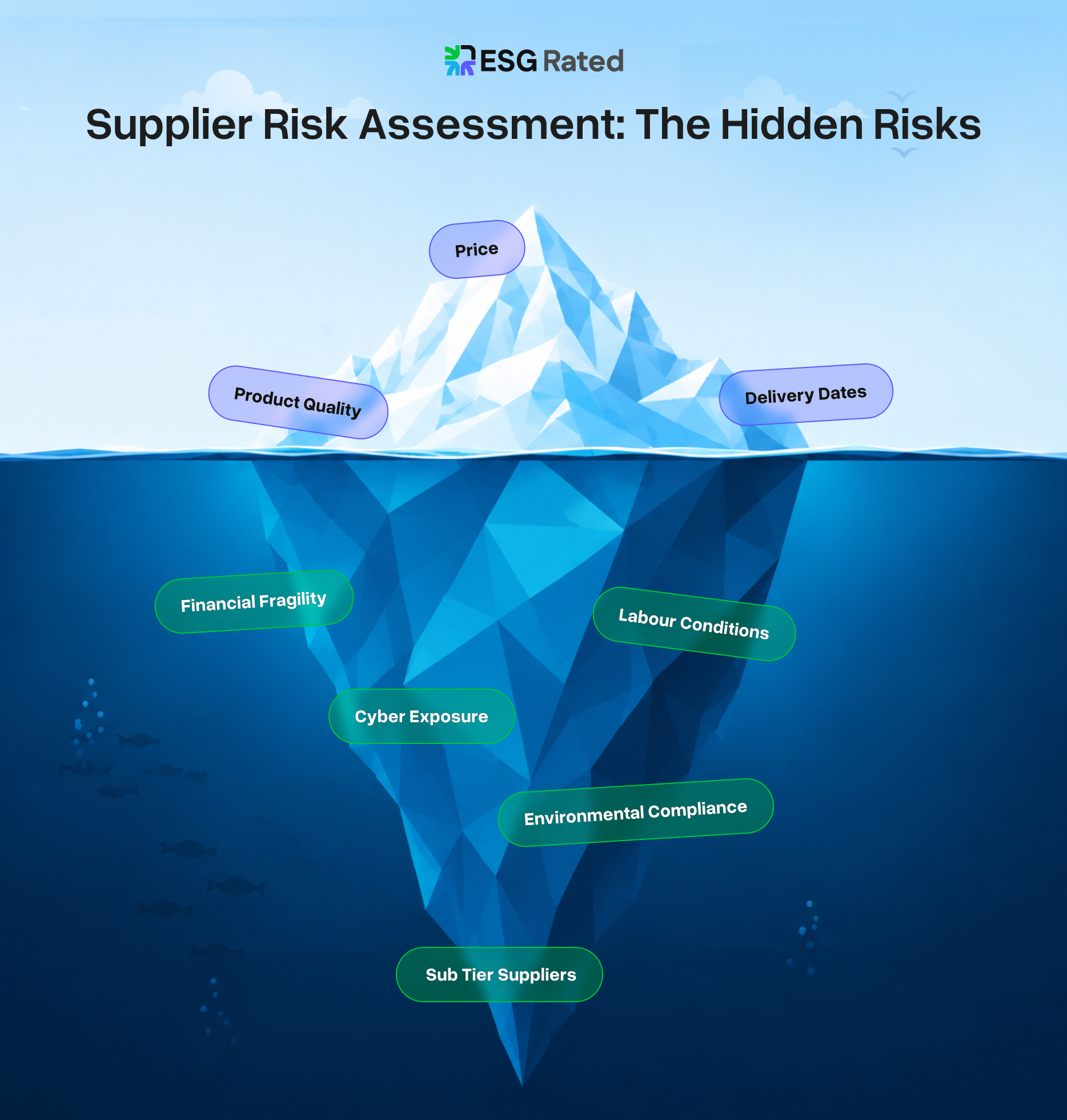
That “something” can be almost anything. A key supplier goes bankrupt mid-contract. A factory catches fire because a fire exit was welded shut. A subcontractor three tiers down uses child labour. A logistics partner gets hit with ransomware and your shipments stop moving. None of these show up on a standard credit check, which is exactly why supplier risk assessment has grown into its own discipline, separate from basic vendor vetting.
It’s worth being precise about a distinction people often blur: a vendor risk assessment usually means IT and data security screening (does this vendor meet ISO 27001 or SOC 2, can they be trusted with your customer data). A supplier risk assessment is broader. It covers commercial stability, operational reliability, human rights, environmental performance, and governance, on top of security. If you buy physical goods, run manufacturing, or operate a multi-tier supply chain, you need the wider version, not just the IT checklist.
The risk categories:
Most guides list four or five risk buckets and move on. The categories only mean something once you can picture what they look like in practice, so here’s each one with a case that actually happened.
Financial and operational risk
A supplier’s balance sheet problems become your problem the day they can’t deliver. The 2021 global chip shortage showed this at scale: automakers who had no visibility into their tier-2 and tier-3 semiconductor suppliers were caught completely off guard, some cutting production for over a year. The same year, the Suez Canal blockage showed how a single chokepoint, unrelated to any one supplier’s conduct, can freeze an entire network. Financial and operational risk assessment means checking not just “is this supplier solvent today” but “what happens if their supplier’s supplier goes down.”
Human rights and labour risk
This is where supplier risk assessment has the deepest history and the highest stakes. The Rana Plaza factory collapse in Bangladesh in 2013, which killed over 1,100 garment workers, remains the reference point for why buyers can’t outsource responsibility for what happens in a subcontracted factory. Closer to the present, the 2020 investigation into Leicester garment factories supplying Boohoo, which uncovered workers paid well below minimum wage during COVID lockdowns, showed that these risks aren’t confined to the other side of the world or to companies without sustainability programmes. Boohoo had ESG commitments on paper. It didn’t have verified visibility into what was happening on its own supplier’s factory floor.
Environmental risk
Water use, pollution, and waste aren’t abstract line items, they carry real liability. Textile dyeing suppliers discharging untreated wastewater into rivers in parts of South and Southeast Asia have triggered plant shutdowns ordered by local regulators with no warning to the buyer, which is a supply risk as much as an environmental one.
Governance, ethics, and corruption risk
Bribery, sanctions exposure, and conflicts of interest at a supplier can attach to the buyer through anti-corruption laws like the UK Bribery Act or the US FCPA, even when the buyer had no direct knowledge. Sanctions screening failures have hit companies hard in the last few years as trade restrictions have shifted quickly with geopolitical events.
Cybersecurity risk
Supply chains are now a favoured entry point for attackers precisely because a supplier’s systems are often less protected than the buyer’s own. Ransomware attacks on logistics and manufacturing partners have repeatedly caused multi-week shipment delays for companies that had never audited their supplier’s basic security posture.
The regulatory picture in 2026 (and why it’s more complicated than a checklist)
Supplier risk used to be mostly a commercial concern. It’s now also a legal one, though the legal landscape shifted meaningfully over the last year, and treating it as static is a mistake. Here’s where things actually stand, region by region.
European Union. The Corporate Sustainability Due Diligence Directive (CSDDD) requires large companies to identify and address human rights and environmental risks across their value chain. But the directive most people learned about in 2024 is not the directive in force today. The EU’s “Omnibus I” simplification package, published in the Official Journal in February 2026, narrowed the CSDDD considerably: it now applies only to EU companies with more than 5,000 employees and over €1.5 billion in worldwide turnover (plus non-EU companies with comparable EU turnover), the mandatory climate transition plan requirement was dropped, and full compliance isn’t required until July 2029. Companies can also now focus their due diligence on where impacts are “most likely and most severe,” rather than mapping every tier equally. Anyone still budgeting for the original 2024 version of this law is planning against a rule that no longer exists in that form. The European Commission’s official CSDDD page tracks the current scope and timeline.
Germany. The national LkSG (Supply Chain Due Diligence Act) is being wound down ahead of the CSDDD transposition. Germany’s regulator, BAFA, suspended its report review process from October 2025, and the annual reporting obligation is being scrapped, with only serious violations still subject to fines in the meantime. The underlying due diligence obligations, risk analysis, a complaints procedure, preventive measures, are still legally required for now, just less strictly policed. Details are published by Germany’s Federal Office for Economic Affairs and Export Control (BAFA).
United States. There’s no federal supplier ESG due diligence law, but California has effectively created one through climate disclosure rules. SB 253 requires companies over $1 billion in global revenue doing business in California to report Scope 1 and 2 emissions (the direct emissions from their own operations and purchased energy), with the first deadline pushed back to November 10, 2026 by the California Air Resources Board, and Scope 3 emissions (everything in the value chain, including suppliers) due from 2027. SB 261, covering climate financial risk reporting, has had its enforcement paused by a Ninth Circuit injunction while a First Amendment challenge plays out. The practical effect for suppliers: any company selling into a large Californian buyer is increasingly being asked for emissions and risk data it never had to produce before. Current status is tracked by the California Air Resources Board.
India. SEBI’s Business Responsibility and Sustainability Report (BRSR) and its more demanding subset, BRSR Core, apply to India’s largest listed companies, phasing in from the top 150, to the top 250, to the top 500 in FY 2025-26, and up to the top 1,000 by FY 2026-27, based on market cap. Value chain disclosure, meaning ESG data on major suppliers and customers representing 2% or more of purchases or sales, was originally set to become mandatory, but SEBI eased this to a voluntary basis in March 2025 to give companies more time to build data collection systems. If you supply into a large Indian listed company, expect the request for value chain data to keep growing even though it isn’t compulsory yet. Details sit with the Securities and Exchange Board of India.
Global baseline. Underneath all of these national and regional rules sits the same reference framework almost everyone builds from: the OECD Guidelines for Multinational Enterprises and its due diligence guidance. Even where a specific law doesn’t apply to you, regulators, investors, and buyers increasingly expect a risk-based process that follows this shape: identify risk, prioritise the worst of it, act on it, track whether the action worked, and be able to show your work.
Disclaimer: Regulations move quickly and vary by jurisdiction, company size, and sector. This section reflects the publicly available status of these rules as of mid-2026. It is general information, not legal advice, and you should confirm current requirements with qualified counsel or the relevant regulator before making compliance decisions.
How to actually run a supplier risk assessment (a real process, not a checklist)
Most supplier risk guidance describes a version of “screen, assess, monitor, repeat.” That’s not wrong, it’s just too thin to be useful. Here’s a version with the detail that actually determines whether it works.
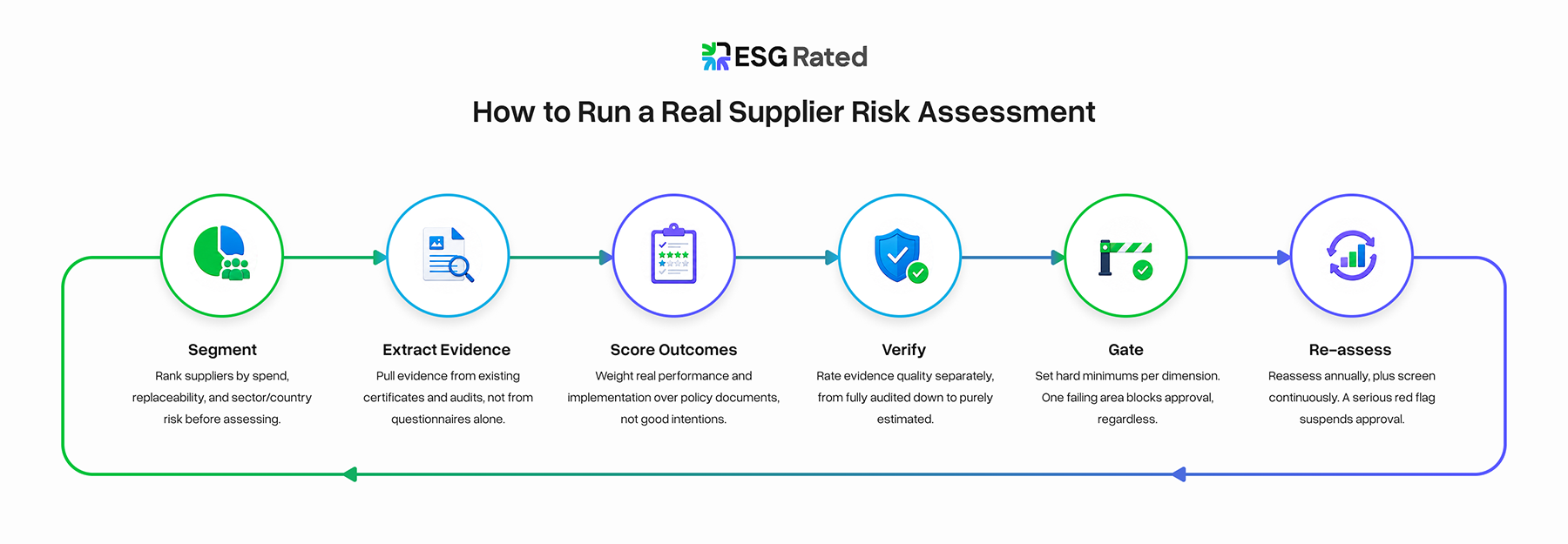
Step 1: Segment your supplier base before you assess anything
Not every supplier deserves the same depth of scrutiny. Rank suppliers by spend, by how easily they could be replaced, and by the inherent risk of their sector and country (a garment factory in a high-risk sourcing region carries different baseline risk than a domestic software vendor). This single step is what keeps a supplier risk programme manageable at scale instead of drowning procurement teams in equal-depth questionnaires for a thousand suppliers, most of whom carry limited exposure.
Step 2: Start from evidence your suppliers already have, not a blank questionnaire
The single biggest reason supplier assessments produce weak data is that they start with a form and ask the supplier to fill it in from memory. A far more reliable approach starts with the documents a supplier already holds, safety certificates, utility bills, audit reports, payroll records, and extracts verifiable data points from them, each one tied to a specific page in a specific document. Only the genuine gaps, the things no document covers, become questions. This is the model ESG Rated uses across its own rating process: analysts review every extracted data point before it counts, and self-reported answers only fill the space evidence doesn’t reach.
Step 3: Score outcomes, not intentions
A supplier with a beautifully written anti-corruption policy that nobody has trained on and no one enforces is not a low-risk supplier. Weight actual performance and management systems well above policy documents. A policy earns credit only when it’s genuinely adopted (customised to the company, signed off, connected to real implementation), not copy-pasted boilerplate.
Step 4: Assign a verification level, separately from a performance score
This is the part almost every supplier assessment gets wrong: it blends “how good is this supplier” with “how sure are we” into one number. Keep them apart. A supplier can perform well on paper while that performance rests entirely on self-reported claims nobody has checked, and a buyer who only sees a blended score has no way to tell the difference between a well-verified 70 and a self-declared 70. Track evidence quality on its own scale, roughly: independently audited, documented and analyst-reviewed, self-reported and plausibility-checked, self-reported and unchecked, or estimated. And let evidence expire. Data more than a year or so old should be treated as stale, because a supplier’s circumstances change.
Step 5: Set gates, not just thresholds
A supplier shouldn’t be able to reach “approved” status purely on a high average score while one dimension is badly failing. Build in hard gates: no medal-equivalent status if safety data is entirely self-reported and unaudited, no approval if any single risk dimension (say, labour practices) falls below a minimum bar, regardless of how well the supplier scores elsewhere on cost or delivery.
Step 6: Re-assess on a real cycle, and screen for controversies in between
An assessment from eighteen months ago tells you almost nothing about a supplier’s current risk. Build in a fixed reassessment cycle (annually is standard) and screen continuously for adverse news, regulatory actions, or credible reports in between. A serious controversy should be able to suspend a supplier’s approved status immediately, not wait for the next scheduled review.
A worked example
Take a mid-size UK homeware retailer sourcing ceramics from three factories in South and Southeast Asia, plus a domestic logistics partner. Under a checkbox approach, all four suppliers might get the same annual questionnaire and come back with similar-looking scores, because self-reported answers tend to cluster near the top.
Run it properly instead. Segmentation puts the two overseas ceramics factories in the highest-risk tier (spend concentration, sourcing region, physical manufacturing hazards) and the logistics partner in a lower tier. For the ceramics factories, evidence extraction pulls real data from existing fire safety certificates and third-party social audits already on file, rather than asking the factory to self-certify from scratch, and flags that one factory’s most recent audit is fourteen months old and due for refresh. The questionnaire that follows covers only what those documents don’t, mainly around a recent change in subcontracted logistics providers on the ground. Scoring weights the actual safety incident record and worker interview findings from the third-party audit heavily, giving light credit to the factory’s written safety policy alone. The verification level on the labour data comes back as independently audited for one factory and self-reported for the other, a distinction a blended score would have hidden entirely. That gap alone is the finding worth acting on, not the headline number.
Common mistakes that quietly undermine supplier risk programmes
- Treating the first assessment as the finish line. Risk isn’t static. A supplier that passed cleanly last year can have new management, a new subcontractor, or a new financial problem this year.
- Asking every supplier the same depth of questions. This burns internal resources on low-risk suppliers while starving the genuinely risky ones of proper attention.
- Accepting self-reported claims without any independent check. Self-reported data has a place, it’s often all that’s available for smaller suppliers, but it needs to be labelled as such, not presented with the same confidence as audited data.
- Losing sight of sub-tier suppliers. Most severe incidents, including Rana Plaza, happened at subcontractor or sub-tier level, below the supplier a buyer had a direct contract with.
- No mechanism to react to news between assessment cycles. A credible report of a labour violation shouldn’t sit unaddressed for eleven months until the next scheduled review.
Where ESG Rated fits into this
Everything above, evidence over self-declaration, a performance score kept separate from a verification level, gates that stop a strong score from hiding weak proof, is the exact model ESG Rated built its own rating methodology around, and it applies just as well to rating your suppliers as it does to getting rated yourself.
If you’re a company trying to build a defensible supplier risk assessment programme, or a supplier trying to prove your own performance to buyers who increasingly demand evidence rather than a filled-in form, ESG Rated gives you an audit-ready rating built on documents and citations, not self-scored checklists, with a Performance score and a separate Verification letter so nobody has to guess how much to trust the number. Visit esgrated.com to see how a rated scorecard, and an exportable supplier network view, could work for your organisation.
FAQ
An assessment is usually a broader, ongoing review using documents, data, and sometimes questionnaires. An audit is typically a deeper, often on-site, check of one supplier against a specific standard. Most mature programmes use assessments to decide where audits are worth the cost.
Once a year for most suppliers is standard, more often for your highest-risk, highest-spend suppliers, and immediately if a serious controversy or incident comes to light.
The expectation should scale with company size, a 30-person supplier isn’t expected to have a full board-level sustainability committee, for example. What shouldn’t scale down is the basic evidence standard: claims still need something behind them, whatever the supplier’s size.
No, but it should never be presented as equivalent to independently verified data. Label it clearly, and treat a claim without any supporting evidence as not yet counted, rather than accepted at face value.
It depends on your own company’s size, revenue, and where you do business, not just where your suppliers sit. A company based in California over the relevant revenue threshold has different obligations than one based in the EU under the CSDDD’s narrowed scope. Check applicability against your own company’s profile with qualified counsel, since thresholds and deadlines have moved more than once in the last two years.
Not a specific bad number, but a mismatch: a supplier claiming strong performance with no evidence to back it up, or evidence that’s badly out of date. That gap is usually where the real risk is hiding.
Last updated: June 2026. Regulations and rating methodologies change regularly. Always verify current requirements with the relevant regulatory authority or rating agency.