Read summarized version with:
 ChatGPT
 Gemini
 Perplexity
 Claude
 Grok
Grok
Quick Summary
ESG due diligence is the process a company uses to find, assess, and fix environmental, social, and governance (ESG) risks in its own operations and across its suppliers, partners, and investment targets. Companies use it before mergers and acquisitions, when onboarding new suppliers, when raising capital, and as an ongoing check on how their business affects people and the planet.
Here is what you need to know in the next 60 seconds:
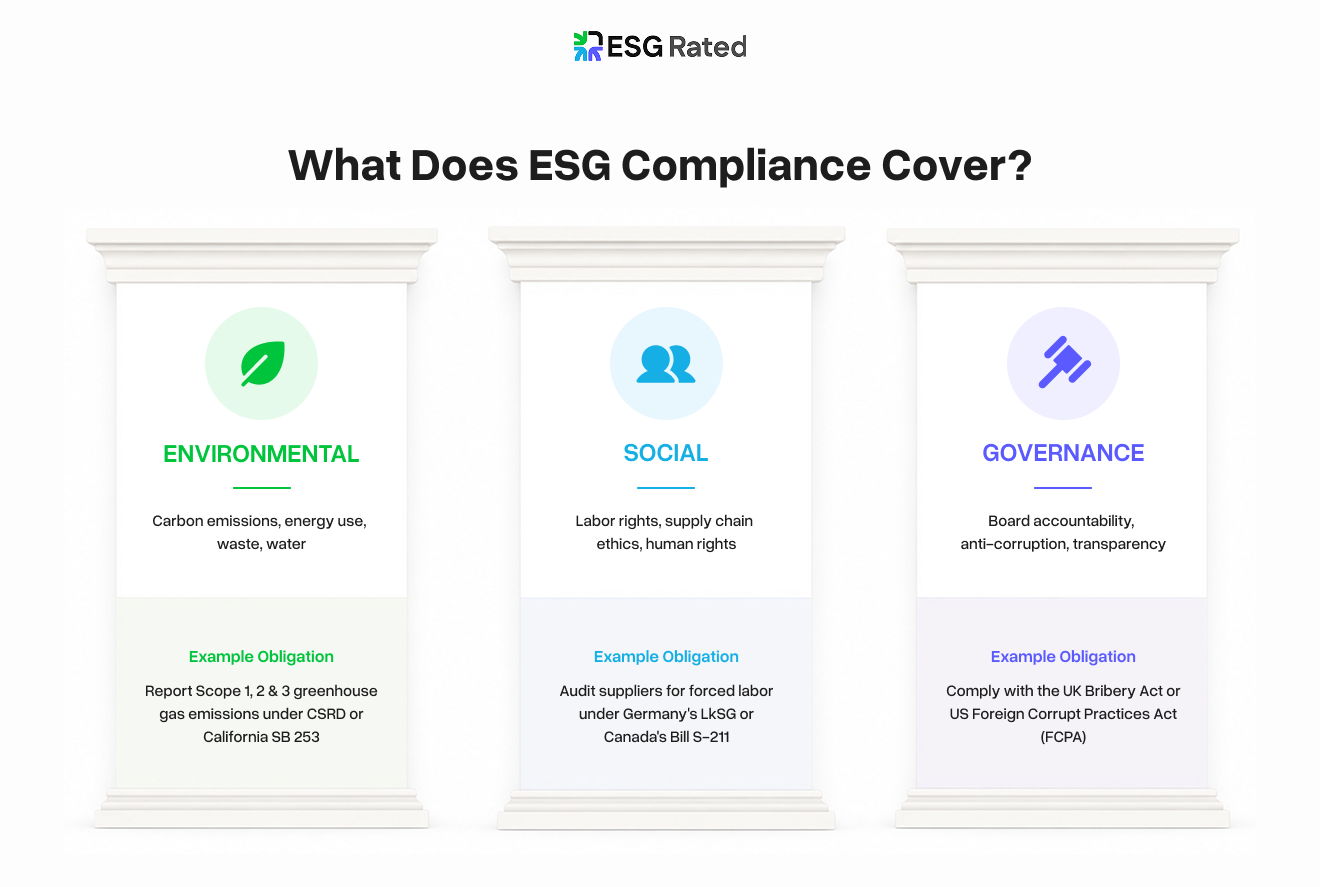
- ESG due diligence covers three areas: environmental impact (emissions, waste, resource use), social impact (labor rights, community relations, health and safety), and governance (board oversight, ethics, anti-corruption controls).
- It differs from ESG reporting. Reporting tells the story of what already happened. Due diligence is the investigative work that finds problems before they become headlines, lawsuits, or contract cancellations.
- Regulation is tightening in some regions and loosening in others. The European Union has narrowed its Corporate Sustainability Due Diligence Directive (CSDDD) but kept it in force. The United States has scaled back federal climate disclosure rules while California pushes ahead with its own mandates.
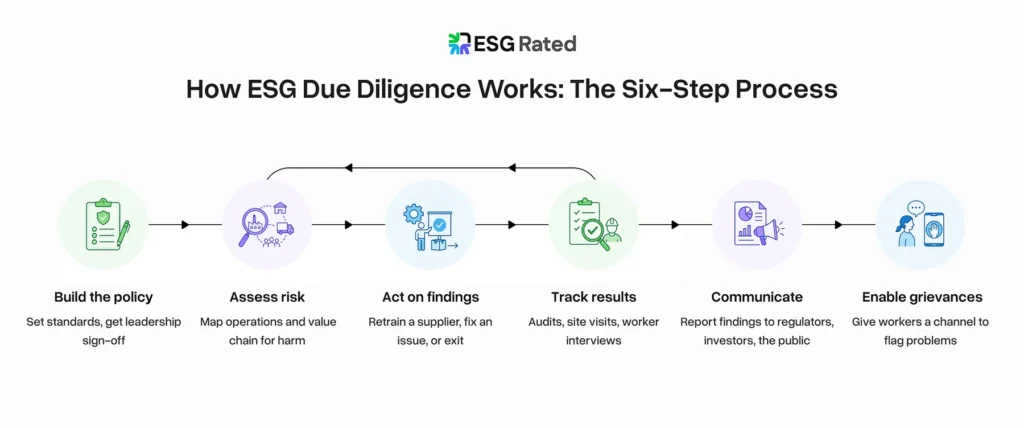
- A proper ESG due diligence process follows six recognizable steps: build a policy, map and assess risk, act on what you find, track results, communicate openly, and give people a way to raise concerns.
- Supplier and vendor risk is now the biggest blind spot for most companies, because a business can control its own factory floor but has far less visibility into its supplier’s supplier.
- Companies that want audit-ready, third-party verified ESG ratings for themselves and their entire supplier network can get that through ESGRated.com, which is built specifically to make due diligence faster and defensible.
If you only needed the summary, you now have it. Everything below goes deeper, with real examples, region-by-region rules, and a practical framework you can actually use.
What Is ESG Due Diligence and Why Does it Matter
ESG due diligence means checking a company, a supplier, or an investment target against environmental, social, and governance standards before you commit money, sign a contract, or publish a claim about sustainability.
Break down the acronym and it gets simple fast:
- Environmental covers how an organization treats the natural world: carbon emissions, water use, waste disposal, deforestation risk, and biodiversity impact.
- Social covers how an organization treats people: factory worker safety, fair wages, child labor prevention, community relations, and data privacy.
- Governance covers how an organization runs itself: board independence, executive pay, anti-bribery controls, and whistleblower protection.
Due diligence, in plain terms, means doing your homework before you act. Lawyers and bankers have used the term for decades in financial deals, checking a target company’s books before a merger. ESG due diligence applies that same instinct to sustainability and ethics questions.
The distinction matters because a lot of companies confuse “we publish a sustainability report” with “we did our due diligence.” A sustainability report is a summary written after the fact, often with the company’s own data. Due diligence is the investigative process, ideally checked by an independent party, that happens before a decision gets made and continues on an ongoing basis afterward.
Why ESG Due Diligence Matters for Every Business Right Now
Three forces are pushing ESG due diligence from a nice-to-have into a business requirement.
Investors ask harder questions. Private equity firms, banks, and institutional investors now routinely build ESG checks into their standard due diligence process alongside financial and legal review. A fund that skips this step risks buying into a company with hidden liabilities, like an unresolved labor dispute or an environmental cleanup obligation that never made it onto the balance sheet.
Customers and buyers demand proof, not promises. Large retailers, automakers, and electronics brands increasingly require their suppliers to pass ESG screening before they win a contract. A supplier that cannot produce documentation on labor practices or emissions data risks losing the business entirely, regardless of price or quality.
Regulators are building legal teeth into the requirement, though how much teeth varies sharply by country and is genuinely still shifting, which the regional section further down explains in detail.
Beyond the external pressure, there is a simpler business case. Problems found early cost far less to fix than problems discovered after a product recall, a factory fire, or a supply chain scandal reaches the news. A due diligence process is essentially a smoke detector. It does not stop every fire, but it gives a company the chance to act before the building burns down.
ESG Due Diligence vs ESG Reporting: What Actually Separates Them
People use these terms interchangeably, and that confusion causes real problems.
ESG reporting is backward-looking. A company gathers data on last year’s emissions, workforce diversity, and safety incidents, then publishes it in an annual report, often to satisfy investors, regulators, or public curiosity.
ESG due diligence is forward-looking and investigative. It asks: what could go wrong here, where is it most likely to go wrong, and what do we do about it before it does? It applies not just to a company’s own operations but to everyone it does business with, including suppliers several tiers removed from direct contact.
A useful way to picture the difference: reporting is the annual physical exam a company gives itself. Due diligence is the ongoing work of eating well, exercising, and catching a problem through routine bloodwork long before it turns into an emergency room visit.
Companies that only report, without doing the underlying diligence work, run a real risk of “greenwashing,” a term for making environmental or social claims that sound better than the underlying reality. Regulators in several countries have started fining companies for exactly this gap between what gets published and what actually happens on the ground.
How ESG Due Diligence Works: The Six-Step Process
Most credible due diligence frameworks, including the one built into the EU’s due diligence law, trace back to guidance from the Organisation for Economic Co-operation and Development (OECD), an international body that sets standards for responsible business conduct. The process breaks down into six steps.
Step 1: Build the policy. A company writes down what it expects from itself and its partners on labor, environment, and ethics, and gets leadership to formally commit to it.
Step 2: Identify and assess the risk. This is the investigative core. A company maps its own operations and its value chain (all the suppliers, contractors, and partners involved in making and delivering a product) to find where harm is most likely and most severe. A garment brand sourcing cotton from a region with known forced labor risk, for example, needs to look harder there than at its head office stationery supplier.
Step 3: Act on what you find. Once a risk turns up, a company has to actually do something: retrain a supplier, change a sourcing location, fix a safety issue, or in serious cases, end the relationship.
Step 4: Track whether it worked. Fixing a problem once does not mean it stays fixed. Ongoing monitoring, through audits, site visits, and worker interviews, confirms the corrective action actually holds.
Step 5: Communicate openly. Companies need to be able to explain, to regulators, investors, and the public, what they found and what they did about it.
Step 6: Provide a way to raise concerns. Workers, community members, and other affected people need a channel, like a grievance mechanism or hotline, to flag problems the company might have missed.
ESG Due Diligence in Mergers and Acquisitions
When one company buys another, ESG due diligence sits alongside financial, legal, and tax review as a standard part of the deal process.
A private equity firm evaluating a manufacturing target, for instance, will typically send a team to check the target’s environmental permits, review any pending labor complaints, look at the diversity and independence of its board, and confirm there are no active investigations into bribery or corruption. If the target has unresolved environmental contamination on a factory site, that liability can follow the buyer after the deal closes, sometimes costing far more than the original purchase price implied.
This is not theoretical. Deals have collapsed, or been repriced downward at the last minute, after due diligence teams uncovered undisclosed pollution liabilities, unpaid wages, or falsified safety records. A buyer who skips this step is essentially buying a house without a home inspection.
ESG Due Diligence for Supply Chains and Suppliers
This is where most companies genuinely struggle, and it deserves its own section because supply chain risk is different in kind from operational risk.
A company can walk through its own factory and see conditions firsthand. It usually cannot walk through its supplier’s supplier’s factory on the other side of the world. Risk tends to concentrate several tiers deep in a supply chain, in the raw material extraction or first-stage processing stages, precisely where visibility is weakest.
Two well-documented historical examples illustrate why this matters. The 2013 Rana Plaza factory collapse in Bangladesh, which killed over a thousand garment workers, exposed how little visibility major clothing brands had into the actual conditions inside factories producing their goods, even when those factories were several tiers down their supply chain. It became one of the defining events that pushed the entire apparel industry toward mandatory supplier auditing programs.
Cocoa sourcing offers another instructive case. Major chocolate manufacturers have faced years of scrutiny and litigation over child labor risk in cocoa farming regions in West Africa, an issue that sits at the very start of the supply chain, far from the manufacturer’s own factories, and is genuinely difficult to monitor without dedicated on-the-ground verification programs.
The practical lesson: a supplier questionnaire alone does not count as due diligence. Verified, audit-based supplier screening, ideally refreshed on a regular cycle rather than a one-time check, is what actually reduces risk. This is precisely the gap ESGRated.com is built to close, giving companies a way to secure trusted, audit-ready ESG ratings not just for themselves but across their entire supplier network, so a due diligence claim is backed by verified evidence rather than a self-reported form. If your supplier base spans multiple countries or tiers, it is worth visiting esgrated.com to see how a verified rating system can replace guesswork with documentation.
Regional Regulatory Landscape: How ESG Due Diligence Rules Differ by Country
This is the area where accuracy matters most, and where things have moved quickly. The information below reflects the regulatory situation as of mid-2026. Rules in this space change often, so treat this as a starting point for your own research rather than a final word, and always confirm current requirements with qualified legal counsel before making compliance decisions.
European Union
The EU’s Corporate Sustainability Due Diligence Directive (CSDDD) is the world’s most far-reaching due diligence law. It requires very large companies to identify and address human rights and environmental harm across their own operations and their value chains.
The directive has gone through a major simplification process known as the “Omnibus” package. Following amendments finalized in early 2026, the directive now applies only to EU companies with at least 5,000 employees and €1.5 billion in worldwide turnover, and to non-EU companies with at least €1.5 billion in turnover generated within the EU. That is a significantly smaller group of companies than the law originally targeted. The mandatory EU-wide civil liability rule, which would have let harmed parties sue companies directly under the directive, was also removed from the final text, and the requirement for companies to adopt formal climate transition plans was deleted. Member states now have until July 2028 to write the rules into national law, with actual compliance required from mid-2029 for most obligations. You can review the official scope and timeline directly on the European Commission’s corporate sustainability due diligence page.
The related Corporate Sustainability Reporting Directive (CSRD), which governs what companies must disclose publicly, was narrowed in the same reform. Even smaller businesses that fall outside the mandatory rules can still choose to report voluntarily under a simplified standard designed for small and medium-sized companies.
United States
The US picture looks almost the opposite of the EU’s. There is no comprehensive federal ESG due diligence law. The Securities and Exchange Commission (SEC) adopted a climate disclosure rule in 2024 that would have required public companies to report climate risks and emissions data, but the agency paused its legal defense of the rule in 2025 and, in mid-2026, formally proposed rescinding it entirely, citing concerns that it exceeded the agency’s legal authority. You can read the SEC’s own proposal directly on SEC.gov.
That federal retreat has not stopped state-level action. California’s Climate Corporate Data Accountability Act (SB 253) and its companion climate risk law (SB 261) require large companies doing business in the state to disclose emissions and climate-related financial risk, with the first emissions reporting deadline landing in August 2026. Because California’s economy is large enough to affect national supply chains, many companies headquartered outside the state still fall under these requirements if they do meaningful business there.
United Kingdom
The UK does not have a single unified due diligence law like the EU’s CSDDD. Instead, it relies on a patchwork: the Modern Slavery Act requires large companies to publish an annual statement on steps taken to prevent forced labor in their operations and supply chains, and separate rules cover areas like deforestation-linked commodities. The UK government has discussed a broader mandatory due diligence law at various points but has not enacted one as sweeping as the EU’s.
Germany
Germany’s Supply Chain Due Diligence Act (Lieferkettensorgfaltspflichtengesetz, often shortened to LkSG) predates and partly inspired the EU directive. It requires large companies operating in Germany to monitor their supply chains for human rights and environmental risk, with its own enforcement and reporting mechanism running alongside the evolving EU framework.
Asia-Pacific and Emerging Markets
Requirements vary widely across the region. Japan has voluntary but increasingly influential guidelines on supply chain human rights. India has moved toward mandatory sustainability reporting for its largest listed companies through its Business Responsibility and Sustainability Reporting (BRSR) framework. Singapore and Hong Kong have both introduced climate-related disclosure expectations tied to international reporting standards for listed companies. Companies operating across these markets often find that the EU’s rules, because of how many global suppliers touch the EU market somewhere in their chain, end up setting the practical baseline even in countries with lighter domestic law.
Disclaimer: Regulations described above reflect publicly available information as of the article’s publication date and are provided for general informational purposes only. Laws in this area change frequently and vary by jurisdiction, company size, and industry. This article is not legal advice. Companies should consult qualified legal counsel to confirm which requirements apply to their specific situation before making compliance decisions.
Real-World Examples of ESG Due Diligence Gaps and What They Cost
Looking at actual cases makes the abstract idea of “risk” concrete.
Volkswagen’s emissions scandal, uncovered in 2015, showed what happens when governance controls fail internally. The company had installed software in diesel vehicles designed to cheat emissions tests. It was ultimately a governance and internal control failure as much as an environmental one, and it cost the company tens of billions of dollars in fines, settlements, and reputational damage. Stronger internal due diligence and whistleblower channels could plausibly have surfaced the issue years earlier.
Boohoo’s Leicester supply chain investigation in 2020 revealed that garment workers at UK factories supplying the fast-fashion retailer were reportedly paid far below minimum wage and worked in unsafe pandemic-era conditions. The company’s share price dropped sharply within days of the reporting, and it lost partnerships with major online retailers that had been carrying its products. The case became a widely cited example of what happens when a brand relies on supplier self-certification instead of independent, verified audits.
Rana Plaza, mentioned earlier, remains the starkest example in modern supply chain history and is directly credited with accelerating the global push toward mandatory supplier auditing and the eventual creation of binding due diligence laws in Europe.
Each of these cases shares a common thread: the underlying problem existed well before it became public, and in each case, a more rigorous, independently verified due diligence process had a realistic chance of catching the issue earlier, when it was cheaper and easier to fix.
Common Challenges Companies Face During ESG Due Diligence
Companies trying to build a real due diligence process run into a handful of recurring obstacles.
Data quality is inconsistent. Suppliers self-report information using different formats, different definitions, and sometimes simply inaccurate figures, which makes comparison across a supplier base difficult without a standardized scoring method.
Visibility drops off after the first tier. A company usually knows its direct suppliers well but loses visibility quickly at the second and third tier, precisely where labor and environmental risk tends to concentrate.
Resources are limited, especially for smaller companies. A large multinational can staff a dedicated ESG compliance team. A mid-sized manufacturer often cannot, which is part of why third-party verification services have grown so quickly in recent years.
Regulatory uncertainty makes planning hard. With the EU narrowing its rules, the US pulling back federally while states move independently, and various national laws evolving on different timelines, companies reasonably struggle to know exactly which standard to build toward.
Verification is harder than collection. Gathering a supplier’s self-reported answers is the easy part. Confirming those answers reflect reality, through audits, site visits, or independent scoring, is where most internal programs fall short.
How to Build an ESG Due Diligence Framework That Actually Works
A practical framework does not need to be complicated to be effective. Based on the six-step process outlined earlier, here is how it translates into an operational checklist:
- Write a clear policy that names specific standards, not vague commitments, and get board-level sign-off on it.
- Segment your suppliers and business partners by risk level, prioritizing higher-risk regions, industries, and raw materials for deeper scrutiny first.
- Use independent verification, not self-reported questionnaires alone, for any supplier above a moderate risk threshold.
- Set a review cadence. Annual reviews work for lower-risk relationships. Higher-risk suppliers need more frequent monitoring.
- Document everything. Regulators, investors, and buyers increasingly want to see evidence, not just a narrative summary.
- Give people a way to raise a red flag, whether that is a worker in a supplier’s factory or an employee inside your own company.
The single biggest upgrade most companies can make is moving from self-reported supplier data to independently verified ratings. Self-reported data tells a company what a supplier wants it to hear. Verified data tells it what is actually happening.
How ESG Rated Helps Companies Get This Right
Doing all of the above manually, across dozens or hundreds of suppliers, is a genuinely heavy lift for most internal teams. ESGRated.com was built to solve exactly that problem. It gives companies a way to secure trusted, audit-ready ESG ratings for their own operations and for their entire supplier network, replacing scattered spreadsheets and self-reported questionnaires with verified, defensible scores that hold up under investor, regulator, or customer scrutiny.
Instead of chasing down supplier surveys one by one, a company can use a single, consistent rating system across its whole value chain, which makes it far easier to spot the riskiest relationships early and show real evidence of due diligence if a regulator, auditor, or major customer ever asks for it.
If your company needs to demonstrate real, verifiable ESG due diligence rather than a paper trail of good intentions, visit esgrated.com to see how the platform can support both your own rating and your supplier network’s ratings in one place.
Frequently Asked Questions About ESG Due Diligence
It means checking a company or supplier for environmental, social, and governance risks before you do business with them, and continuing to check afterward, rather than just trusting what they tell you.
It depends on where you operate and how large your company is. Some large companies operating in or selling into the EU face mandatory requirements under the CSDDD. In the US, there is no comprehensive federal mandate right now, though California has its own state-level climate disclosure rules. Always check current law with a qualified advisor, since this changes often.
An audit is usually a specific, formal check against a defined standard, often done by an independent third party. Due diligence is the broader, ongoing process that audits typically feed into.
Higher-risk suppliers, such as those in regions with weak labor law enforcement, generally need review at least once a year, sometimes more often. Lower-risk suppliers can usually be reviewed less frequently, as long as the risk level is genuinely low and confirmed, not just assumed.
Even if a small business falls outside formal regulatory requirements, it may still need to pass ESG screening to win contracts with larger customers who do have obligations, since those customers often push due diligence requirements down through their own supply chains.
Consequences can include lost contracts, investor pressure, regulatory fines where applicable law exists, reputational damage, and in serious cases, legal liability, particularly in jurisdictions with binding due diligence laws.
Yes, but it gets difficult to scale once a supply chain grows beyond a handful of direct relationships, which is why many companies turn to independent rating and verification platforms to keep the process consistent and credible.
Last updated: July 2026. Regulations and rating methodologies change regularly. Always verify current requirements with the relevant regulatory authority or rating agency.