

Read summarized version with:
 ChatGPT
 Gemini
 Perplexity
 Claude
 Grok
Grok
Quick Summary:
Getting ESG rated means asking an independent assessor to score your company’s environmental, social and governance (ESG) performance, then to publish that score so investors, buyers and partners can verify it.
Here is the process in brief when you get rated with ESGRated:
- You complete a questionnaire built around your sector and company size.
- You upload evidence: policies, certificates, KPIs (key performance indicators) and any third-party proof you have.
- An analyst reviews your submission line by line against recognized global standards.
- You receive two signals, not one: a Performance score from 0 to 100, and a Verification Level from A to E that shows how independently that score has been checked.
- You get a tier and a verifiable badge, along with a clear list of what would raise your score.
A rating usually takes two to four weeks once you submit complete evidence. Most raters, including ESG Rated, score you on four things: your stated intent, how well you implement it, the actual outcomes you produce and how well you can prove all of it. Real performance carries far more weight than paperwork, and a high score paired with a weak verification level will not earn you a top tier.
Read on for the full breakdown, the criteria raters check, the regulations shaping ESG ratings in 2026 and a straightforward FAQ.
What Does It Mean to Get ESG Rated?
ESG stands for environmental, social and governance. It is the set of non-financial factors people use to judge how responsibly a company operates.
An ESG rating turns that judgment into something you can measure. A rating provider reviews your operations, checks your evidence and gives you a score, usually somewhere between 0 and 100, plus a tier or letter grade that sums up where you stand.
The rating itself lives on a public profile. Buyers, investors, regulators and job candidates can look it up and confirm it is current, rather than trusting a badge on a website with no proof behind it.
Why this matters right now: demand for verified ESG data keeps rising faster than the number of companies that actually have it. Large buyers increasingly ask suppliers for a rating before they will sign a contract, and investors use ratings to screen where they put capital.
Why Businesses Get ESG Rated
Companies pursue a rating for a mix of commercial and practical reasons:
- It unlocks bigger contracts. Many large enterprises now require a verified ESG rating before they onboard a new supplier.
- It answers multiple questionnaires at once. A single assessment mapped to major frameworks means you stop rebuilding the same spreadsheet for every buyer that asks.
- It reduces greenwashing risk. A third-party, evidence-based score protects you from accusations that your sustainability claims are unsupported.
- It improves access to capital. Lenders and investors increasingly factor ESG performance into pricing and due diligence.
- It gives you a roadmap. A good rating does not just hand you a number. It tells you exactly which criteria to improve next.
How to Get ESG Rated: Step by Step
The process looks broadly similar across credible rating providers. Here is how it works, using the four-step model that ESG Rated follows as an example.
Step 1: Complete a Tailored Questionnaire
You answer questions that match your sector and company size. A manufacturer faces different questions than a software company, and a 40-person firm faces a shorter form than a 4,000-person one.
Step 2: Upload Your Evidence
You attach policies, certificates and KPIs inside a single secure workspace. You can reuse this evidence in future assessment cycles instead of starting from zero each year.
Step 3: Expert Review
A trained analyst checks every submission against recognized international standards. This step separates credible raters from automated, self-reported scoring tools that never involve a human.
Step 4: Receive Your Score and Badge
You get a scorecard, a tier and a verifiable badge that links back to a live profile. The profile also lists specific, actionable steps you can take to improve your score before the next cycle.
A note on templates and claims: evidence-weighted raters do not award points for having a policy template on file. They score what you actually do and what you actually achieve. If you copy a generic sustainability policy but never implement it, expect that to show up in your score.
What ESG Raters Actually Look At
Most rigorous methodologies assess four broad dimensions. Under the ESG Rated framework, for example, these break into 24 individual criteria.
Environment (E)
Covers climate and nature impacts: greenhouse gas (GHG) emissions across your operations and supply chain, energy use and renewable share, water withdrawal, waste and circularity, pollution, and biodiversity impact.
Social (S)
Covers how you treat people inside and around your business: fair pay, health and safety, training, diversity and inclusion, human rights due diligence, community impact and product responsibility toward consumers.
Governance (G)
Covers the control systems that prevent major failures: board oversight, anti-corruption programs, data privacy and cybersecurity, risk management, tax and lobbying transparency, and whistleblower protection.
Value Chain (VC)
Covers risk that sits upstream and downstream of your own operations: supplier due diligence, responsible sourcing, traceability, human rights across your supply chain, and Scope 3 emissions (the indirect emissions that occur in your value chain rather than your own facilities).
Performance Tiers: What Your Badge Actually Shows
Once you complete a verified assessment, you land on a shared scale that stays consistent everywhere your rating appears: your badge, your scorecard and the rater’s public directory.

Under the ESGRated system, the tiers run as follows:
| Tier | Score range | What it signals |
|---|---|---|
| Platinum | 85 to 100 | Best-in-class performance across every dimension |
| Gold | 70 to 84 | Sector-leading performance with comprehensive disclosure and verified outcomes |
| Silver | 55 to 69 | Strong, evidenced practices and measurable progress year over year |
| Bronze | 40 to 54 | Solid fundamentals in place, with active policies and early performance tracking |
| Committed | Baseline met | Completed a full assessment and met the baseline criteria across all four dimensions |
Every company that completes a verified assessment earns at least Committed status. Performance medals then stack on top of that baseline as your score rises.
Two important guardrails keep these tiers meaningful:
- A minimum Verification Level applies to every medal. A top-tier score cannot be earned on unverified, self-declared data alone, which stops a company from buying a high tier without real proof behind it.
- Scoring below 40 still earns Committed status for transparency, along with a private improvement report. That company simply does not receive a public performance medal until its score improves.
The Scorecard: What Buyers See in Seconds
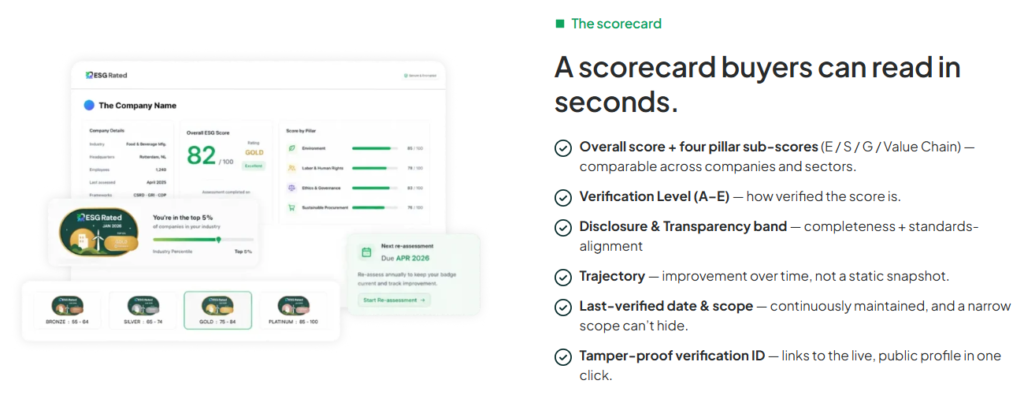
Your rating does not just live as a single badge image. It links to a full scorecard designed so a buyer, investor or procurement team can assess it quickly. A strong scorecard includes:
- Overall score plus four pillar sub-scores for Environment, Social, Governance and Value Chain, comparable across companies and sectors.
- Verification Level (A to E), showing how independently the score has been checked.
- Disclosure and transparency band, reflecting completeness and alignment to recognized standards.
- Trajectory, showing improvement over time rather than a single static snapshot.
- Last-verified date and scope, so the rating stays continuously maintained and a narrow assessment scope cannot hide behind a broad-sounding badge.
- A tamper-proof verification ID, linking in one click to your live, public profile.
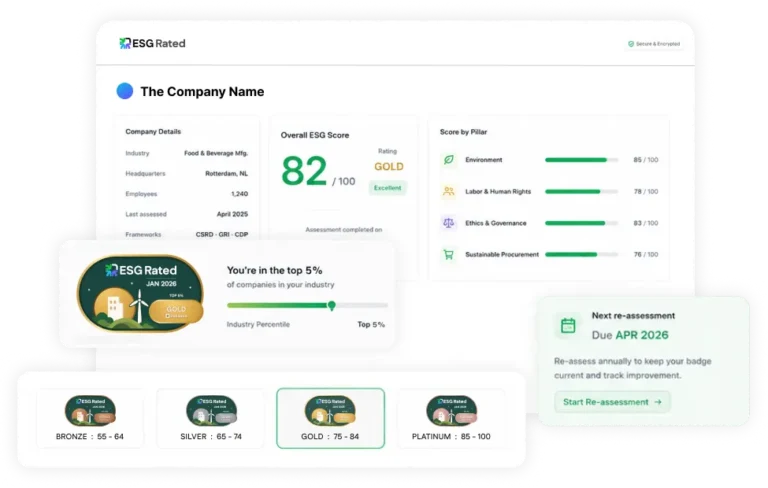
You control visibility. Your scorecard stays private until you choose to publish it. Once public, anyone who has your badge or link can view the live profile.
Your Badge: Display It Anywhere, Verify It Everywhere
Once you complete your assessment, you receive a badge you can add to your website, RFP (request for proposal) responses, email signature and procurement profiles. Unlike a static image, the badge works as a live, checkable credential:
- Scan or click. Every badge links to a live, tamper-proof profile hosted on the rater’s own domain, not a page you control.
- Check the code. Each rating carries a unique verification ID tied specifically to your entity, so it cannot be copied and reused by another company.
- See the evidence. Anyone who clicks through can view your score, tier, assessment date and the exact scope that was reviewed.
This structure is what separates a verifiable badge from a graphic anyone could paste onto a website. If a badge does not link to a live, independently hosted profile, treat it with caution.
How Your Score Actually Gets Calculated
A credible ESG score follows a traceable path from raw evidence to final tier, with no black box in between. Claims without proof do not score, and outcomes outweigh policies at every stage. Here is the path every point follows, using the ESG Rated model as an example:
- Evidence. You submit policies, certificates and KPIs against criteria relevant to your sector.
- Expert review. An analyst verifies each item line by line and assigns it a Verification Level.
- Criterion points. Each of the 24 criteria scores across four layers: Intent, Implementation, Performance and Verification.
- Dimension scores. Criteria roll up into Environment, Social, Governance and Value Chain sub-scores, each from 0 to 100.
- Weighted overall. The four dimensions get weighted by your sector’s materiality to produce your final score and tier.
Within each criterion, the four scoring layers do not carry equal weight:
| Layer | What it measures | Typical weight |
|---|---|---|
| Intent | Policies, commitments and board-level ownership | 15% |
| Implementation | Management systems, certifications, training and coverage | 25% |
| Performance | Actual KPIs, outcomes and trajectory over time | 45% |
| Verification | Evidence quality and third-party verification | 15% |
Notice that Performance carries the heaviest weight. This design choice matters because it stops companies from scoring well purely on paperwork. A business with a strong climate policy but flat or rising emissions year over year will not outscore a business that lacks a formal policy but has cut emissions consistently.
Infographic note 3: “From Evidence to Score, No Black Box” Visual structure: A five-step horizontal flow diagram with arrows connecting each stage left to right, plus a small stacked bar beneath the “Criterion points” step showing the four scoring layers by weight. Concise content:
- Step 1: Evidence, policies, certificates and KPIs submitted
- Step 2: Expert review, analyst verifies line by line
- Step 3: Criterion points, scored on Intent (15%), Implementation (25%), Performance (45%), Verification (15%)
- Step 4: Dimension scores, rolled up into E / S / G / Value Chain
- Step 5: Weighted overall, sector materiality applied for final score and tier
Two Signals, Not One: Score and Verification Level
Most ESG ratings hand you a single number and leave you to guess how it was checked. A more rigorous approach publishes two signals side by side:
- Performance score (0 to 100): how strong your ESG practices and outcomes actually are.
- Verification Level (A to E): how independently that score has been checked.
This second signal matters because a score alone cannot tell a buyer whether to trust it. A Gold-tier score built on audited data means something very different from a Gold-tier score built on self-declared claims, even though the number on paper might look identical. Publishing both signals together prevents a company from buying a good headline number without any proof behind it.
From strongest to weakest, the five Verification Levels are:
- A, Audited: independently assured by a third party through reasonable assurance procedures.
- B, Verified: documentary evidence reviewed line by line by a trained analyst.
- C, Reviewed: self-reported data that an analyst has sense-checked.
- D, Declared: self-reported and not yet independently checked.
- E, Estimated: modeled or inferred where primary data is not yet available.
This distinction matters because two companies can carry the same numeric score while having very different levels of proof behind it. A buyer doing serious due diligence looks at both the score and the Verification Level together, not the score in isolation.
Infographic note 4: “Two Signals: Score vs Verification Level” Visual structure: A two-axis grid. The vertical axis shows the Performance score from 0 to 100. The horizontal axis shows Verification Level from E to A. Plot two example dots: one labeled “Gold, Level A” positioned high on both axes, and one labeled “Gold, Level D” positioned high on the score axis but low on the verification axis. Concise content: Caption underneath: “Same score, different trust. Always check both numbers.”
How Long It Takes and What to Expect
- Timeline: most assessments run two to four weeks from submission to a verified badge, assuming you submit complete evidence promptly.
- Ongoing maintenance: a credible rating is not a one-time event. It carries a “last verified” date and gets maintained on a rolling basis rather than frozen at a single point in time.
- Appeals process: if you disagree with your score, look for a rater that offers a free, structured correction process. You should be able to submit additional or corrected evidence and have an independent reviewer re-evaluate the affected criteria, with no fee required to get re-scored.
- Governance: check whether the rater’s methodology sits under an independent committee, gets versioned and documented like software, and keeps commercial functions separate from scoring. This separation protects you from the concern that a rater inflates scores for paying customers.
The 2026 Regulatory Landscape
ESG ratings now sit inside an active regulatory framework, and the rules shifted meaningfully in the first half of 2026. Here is what is currently in force and why it matters if you are pursuing a rating.
The EU ESG Ratings Regulation Now Applies
Regulation (EU) 2024/3005 on the transparency and integrity of ESG rating activities took effect on 2 July 2026. It does not regulate the companies being rated. Instead, it regulates the rating providers themselves, requiring them to register with the European Securities and Markets Authority (ESMA), disclose their methodology, manage conflicts of interest and separate commercial activity from scoring decisions.
What this means for you as a rated company: it becomes worth checking whether your chosen provider is pursuing ESMA authorization or falls under an equivalent recognition arrangement. A rating from a provider that ignores this framework may carry less weight with EU-based investors and buyers going forward.
The CSRD and CSDDD Scope Narrowed Substantially
The EU’s Omnibus I Directive, which entered into force on 18 March 2026, significantly narrowed two major sustainability laws:
- The Corporate Sustainability Reporting Directive (CSRD) now only applies to EU companies with more than 1,000 employees and over €450 million in net turnover, with reporting starting for financial years from 1 January 2027.
- The Corporate Sustainability Due Diligence Directive (CSDDD) now only applies to companies with more than 5,000 employees and over €1.5 billion in turnover, with compliance required by mid-2029.
Why this matters for a voluntary rating: thousands of mid-sized companies that expected to fall under mandatory CSRD reporting no longer do. For these businesses, a voluntary ESG rating becomes the practical way to demonstrate credibility to buyers and investors who still expect proof, even though the law no longer requires it.
Standards Alignment Still Matters
Even with narrower mandatory scope, credible ratings still map their criteria to the major global frameworks buyers and investors already recognize, including the Global Reporting Initiative (GRI) standards, the European Sustainability Reporting Standards (ESRS), the International Sustainability Standards Board (ISSB) framework, and the Sustainable Finance Disclosure Regulation (SFDR). A single well-mapped assessment can answer several stakeholder questionnaires at once instead of forcing you to fill out each one separately.
Infographic note 4: “2026 ESG Regulatory Timeline” Visual structure: A horizontal timeline with four milestone markers placed left to right by date. Concise content for each marker:
- 18 March 2026: Omnibus I Directive enters into force, narrowing CSRD and CSDDD scope
- 2 July 2026: EU ESG Ratings Regulation applies, bringing rating providers under ESMA supervision
- 2 August 2026: Existing EU rating providers must notify ESMA to continue operating
- 1 January 2027: Narrowed CSRD reporting requirements begin for in-scope companies
How to Choose an ESG Rating Provider
Not every rater applies the same rigor. Use this checklist before you commit:
- Is the methodology public? You should be able to read exactly how scoring works before you submit anything.
- Does a human review your evidence? Fully automated, self-reported scoring carries far less credibility than analyst-reviewed evidence.
- Does performance outweigh paperwork? Check the weighting. A rater that scores policies as heavily as outcomes rewards good intentions over real results.
- Can buyers verify your badge? The badge should link to a live profile with a tamper-proof verification ID, not just display a static image.
- Does it publish a verification level alongside the score? A single number cannot tell a buyer whether to trust it. Look for a rater that shows both a score and how independently that score was checked.
- Is there a fair appeals process? You should be able to correct errors without paying extra to get re-scored.
- Is scoring separated from sales? Ask directly whether commercial relationships influence your score in any way.
- Does it map to standards your stakeholders already ask about? Look for alignment to GRI, ESRS, ISSB, SFDR or similar frameworks so one assessment covers multiple questionnaires.
Common Mistakes to Avoid
- Submitting policies without evidence of implementation. A document alone rarely moves your score.
- Treating the rating as a one-time project. Ratings that carry a “last verified” date reward companies that keep improving year over year.
- Ignoring your weakest dimension. A strong Environment score cannot fully offset a poor Governance or Social score if buyers scrutinize all four dimensions.
- Choosing a rater purely on price. A cheap rating that nobody trusts does not open doors with serious buyers or investors.
- Waiting until a buyer demands proof. Assessments take a few weeks. Starting early avoids losing a deal to a slower process.
FAQ
Cost varies by provider and company size. Ask any rater for a clear quote upfront and confirm there is no pay-to-improve-your-score mechanism, since that would undermine the rating’s credibility.
Most assessments take two to four weeks from a complete submission to a verified badge, though timing depends on how quickly you gather evidence.
For most companies, no. Mandatory reporting laws like the CSRD now apply only to large companies above specific employee and turnover thresholds. Smaller companies pursue ratings voluntarily to win contracts and satisfy buyer and investor requests.
Reporting is you disclosing your own data, often to satisfy a regulation. A rating is an independent third party scoring that data against a standard methodology, which gives it more credibility with outside stakeholders.
Yes. Good providers tailor the questionnaire to company size, so a small business answers a shorter, more relevant set of questions than a large enterprise.
Your scorecard lists specific, prioritized improvement actions. Strengthening outcomes, not just adding more policies, and raising your Verification Level both lift your standing.
You control it. Your scorecard stays private until you choose to publish it. Once public, anyone with your badge or link can view the live profile.
The Performance score, from 0 to 100, measures how strong your ESG practices and outcomes are. The Verification Level, from A to E, measures how independently that score has been checked. A high score with a weak verification level will not earn a top tier.
Look for a provider with a free correction and appeals process. You should be able to submit better evidence and have an independent reviewer re-evaluate the specific criteria in question.
Usually not. A well-mapped rating that aligns to major global frameworks like GRI, ESRS and SFDR can satisfy multiple markets and multiple buyer questionnaires at once.
Ready to Get ESG Rated?
A credible ESG rating gives you a badge buyers can trust, a clear roadmap for improvement and a single assessment that answers most of the ESG questions your stakeholders already ask. ESG Rated runs a transparent, evidence-weighted methodology reviewed by trained analysts, not an automated black box, and publishes the full framework so you know exactly what it takes to improve before you even start.
Start your assessment or explore the full methodology to see how the scoring works in detail.
Last updated: June 2026. Regulations and rating methodologies change regularly. Always verify current requirements with the relevant regulatory authority or rating agency.